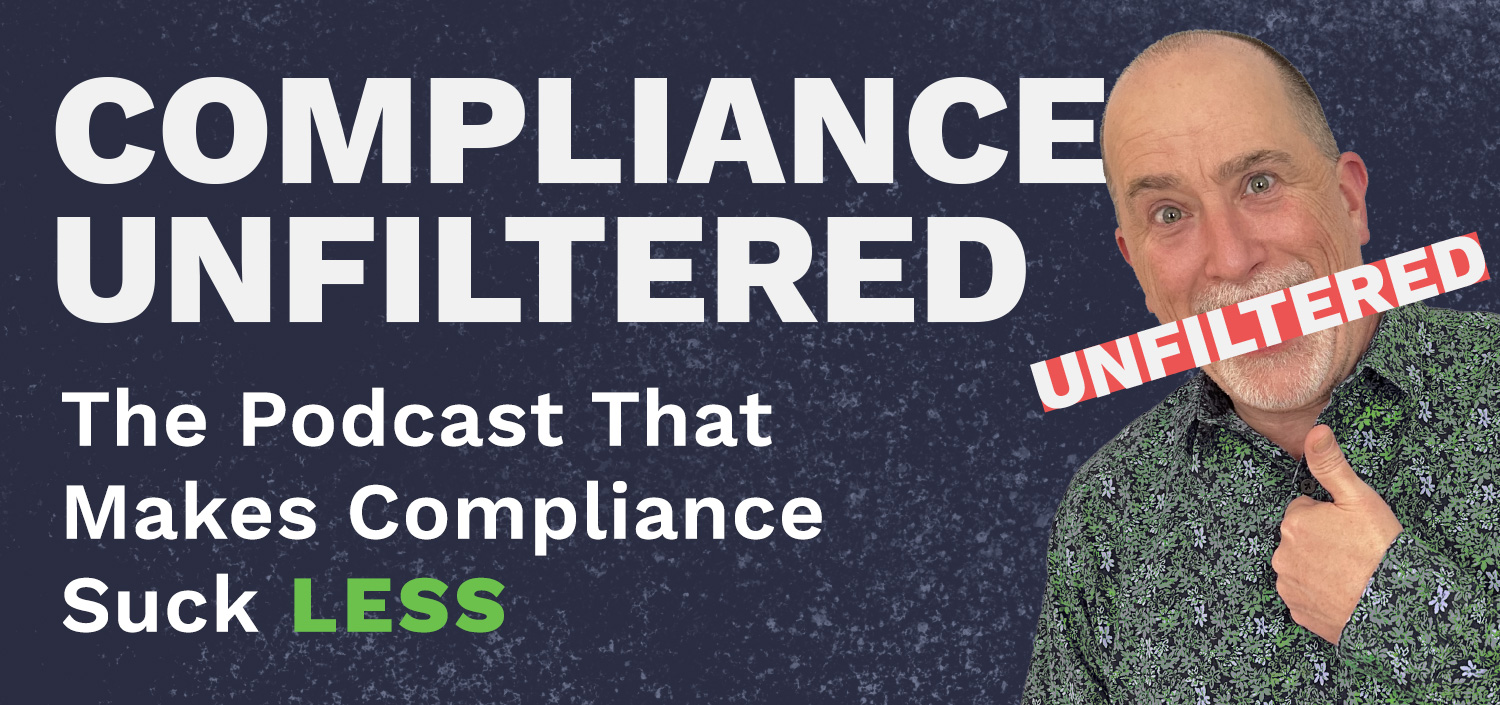
Compliance Unfiltered is TCT’s tell-it-like-it is podcast, dedicated to making compliance suck less. It’s a fresh, raw, uncut alternative for anyone who needs honest, reliable, compliance expertise with a sprinkling of personality.
Show Notes: Vendor B.S. in the Marketplace

Quick Take
On this week’s episode of Compliance Unfiltered, The CU guys get candid and take a dive into the world of vendor relationships and the challenges faced in the marketplace. Adam shares his personal journey from working with “boneheads” to founding his own company, emphasizing the importance of genuine customer service and the pitfalls of AI hype.
With a mix of humor and insight, they explore the disconnect between vendors and clients, offering a refreshing perspective on how businesses can truly serve their customers.
Tune in for an unfiltered discussion that promises to be both enlightening and entertaining.
Read The Transcript
So let’s face it, managing compliance sucks. It’s complicated. It’s so hard to keep organized and it requires a ton of expertise in order to survive the entire process.Welcome to Compliance Unfiltered, a podcast dedicated to making compliance suck less. Now here’s your host, Todd Coshow with Adam Goslin.
Welcome in to another edition of Compliance Unfiltered. I’m Todd Coshow alongside the heavy-eared compliance hot rod, Mr. Adam Goslin. How the heck are you, sir?
I’m doing fantabulous today, Todd. How about yourself?
I’m doing pretty well. Don’t lie to the people. You were feeling extra, extra spicy today. So this will be the perfect opportunity for a truly unfiltered version of compliance unfiltered. We’re going to talk about vendor BS in the marketplace. Talk to me, Adam. How did you come across this topic?
Well, I’ll give the listeners fair warning. So fair warning, if you got little ears that are around and listening to the pod, I like to be cognizant of those when we’re gonna have a particularly spicy version of compliance unfiltered. So this might be one to save for later. So with the warnings and the NCC ratings in hand, I am very glad to be talking about vendor bullshit in the marketplace today. So how’d I come across it? Really, it was just a reflection. We’ve talked over the last several weeks about going to the PCI conferences, both in North America and in EU. And just it’s more of a summary of the interactions that we had with other vendors and other vendors, our existing clients, you know, technical competitor clients that would come up to us and have conversations with us. While we were at the shows, it was kind of a reflection across all of that and saying, you know, this is a topic that I think people will find interesting. So we’re about to find out. So anyway, yeah, if you listen to this one, you’re saying to yourself, you know, hey, that was kick ass, you guys need to do more stuff, whatever. By all means, we’ve said it before, we’d love to get input, feedback, all that fun stuff on either topic you wanna hear, thoughts or comments about the show. You know, we just, we love hearing from you guys and especially when you’re stopping by to see us face to face at the booths and whatnot. So by all means, you know, let us know. You can send an email to [email protected]. That’ll get to you both Todd and myself.
Yes, indeed. Now, Adam, you often say that relationships matter. I actually agree with that completely. And you say that vendors should treat their customers the way that they used to. Tell us more about that.
Well, you know, part of the reason why I decided to go start my own company was quite literally I was working for in my case, man, it was I think it was about 11 years of 11 years and three jobs working for progressively larger scale boneheads than the last person that I worked for. And I finally I just got tired of it. This is ridiculous. I want to be able to go do my own thing. I want to run a company. I know damn well I can do it better than the twits that I used to work for, you know, and so I decided to put my money where my kind of big ass mouth is and go throw my hat in the ring, right? And yeah, it was interesting as I as I got into, you know, kind of being being somebody that clients depended on. It start it just kind of underscored more and more over time, you know, just, you know, how much that relationship, you know, needs to take shape how, you know, how valuable that relationship is. And really the, you know, how far away from what should be happening is what’s actually happening in the marketplace. You know, in many cases that you’re seeing, you’re seeing vendors that are taking clients for granted, you know, just, they’re just a you know, they’re they’re consuming our service and you know, we’re here and we’re provisioning with the with this service and these customers should be just thankful that we’re, you know, blessing them with our brilliance or something I don’t know what in the hell these vendors are thinking, you know, but there used to be a day when your vendors actually gave a shit where your vendors cared where your your opinion as a client mattered. You know, I just earlier this week I was I was having conversations with somebody about, you know, about their vendor and you know, where, you know, they had put, you know, they’d put high priority tickets in that had gone unanswered. And when I say a high priority ticket, I’m talking like legit that this ticket should have been responded to in minutes if not a couple of hours and it’s it’s, you know, a day plus later and they’re just listening to crickets, you know, type type of a thing coming back from from this vendor and you know, it it seems like what’s been happening in the marketplace is that the level of service that vendors provide goes down. Meanwhile, the prices go up and I don’t know, man, it just it just seems completely jacked. What’s what’s going on out there in the marketplace, you know, I almost, you know, I pine for the days where, you know, I don’t know, people used to care about one another and people were nice to one another and people did shit that was appropriate. It’s it’s just it’s really sad seeing, you know, seeing what’s going on, you know, and especially in that, you know, kind of vendor-client relationship, you know, it was it’s just it’s sad to see see what’s going on. And, you know, the the only thing that I can do is I can make sure that damn well, PCT is not going to be that, you know, it’s it’s one of the biggest reasons why I stepped into doing this for myself was, you know, I I knew what the people what the, you know, as I affectionately call them, the dipshits I used to work for before.
It was it was readily apparent the things that they needed to do, although they didn’t do it. And, you know, now that I’m in the in a position where I’m damn sure we’re actually doing what’s right. It’s it’s nice. It’s fun. It’s it’s refreshing. And the best part about it is, you know, seeing the seeing the appreciation from our client base, that’s that that speaks for itself. It’s just it’s awesome being able to, you know, to be able to establish that type of a type of a relationship and and continue that relationship for a long period of time with folks that are TCT clients. That’s that’s for me. That’s what it’s all about.
I have no doubt, at one of the recent shows, you articulated appreciation for her particular group that was the single best referral source for TCT. Talk to the folks about that Adam.
When you and I were kind of talking about what we’re going to talk about and you’re like, yeah, I’m really interested as to how the hell you’re going to be able to pull this one off, you know, in any space you’ve got, you know, you’ve got competitors, right? Well, we found ourselves at one of the shows and one of the folks that would fall into, you know, loosely fall into the bucket of a competitor was also there. And this particular competitor, this particular competitor has, you know, made a, you know, kind of made a name for themselves. You know, they kind of got the big bag of money, as I like to call it, from the, you know, from the investor groups. They’ve made a splashy, you know, splashy interface. They’ve, you know, they’ve got all sorts of snake oil that they’re hawking, you know, the absolutely bewildering wonderment of everything that’s AI, blah, blah, blah, blah, blah. And, you know, so, so, you know, that’s kind of their stick, right? Well, this same group, which, by the way, if you haven’t put it together already, I’m not going to name because they know exactly who they are. And I actually, I hope they kind of, I kind of hope that they’re listening. You know, the reality is, is that, you know, we had, we had existing clients that had gotten approached by them that, you know, that had, you know, kind of seen, seen what they do. And better yet, we had, we had a high volume of their current clients coming over, basically seeking a solution that actually worked, you know, seeking a vendor that actually cared, you know, et cetera. And, you know, honestly, in retrospect, you know, and I mentioned this to, you know, to the folks in TCT that read the show is I was chuckling because honestly, this particular finger quote competitor was literally the single best referral source for TCT that existed at that show. It was it was wild. And so, you know, I, you know, hey, on my side, I’m sitting here going, you know what, you guys don’t do a jam thing different. Don’t do anything different. Continue treating your customers like garbage. Continue to, you know, promote function functionality that doesn’t actually function. Continue to, you know, do you do exactly what you’re doing right now? I love you guys. You’re amazing. So it’s just I found it personally hilarious that the, you know, of the of all the people that were, you know, you know, of the whatever thousand plus people at the show that they were the ones that were the single single best referral source for TCT at the show that that that I found a great deal of iron in.
Now that’s a great lead in to the notion of customer service. Talk to us about really why that’s so important.
Well, part of the conversations that we ended up having with this unnamed competitor is literally people were coming up and having conversations with us talking about how one organization in particular said that they had over 20 different tickets into this organization, none of which had been answered. And they had been out there for weeks type of a thing. And, you know, I’m sitting here going, how in the absolute shit do you call that customer service? I mean, I’m not sure how, I don’t know, I’m not sure how you can even coin it as customer. It’s more a customer disservice. That’s what’s happening at these organizations. It’s like, it’s absolutely nuts. You know, the coolest part about like, and to put it into perspective, TCT as an example. So I feel unbelievably blessed to have the crew that we’ve got that’s taking care of customers because when we have inbound tickets that come into TCT, they’re literally resolved. Oftentimes within business hours, I would call it astoundingly rare that any request goes longer than 24 business hours. And generally, I wouldn’t even call it rare. I haven’t seen any request go 24 business hours, you know, at this organization. So, you know, the cool part is that, you know, we’re taking that responsibility seriously. We’re acting the way that I believe the vendor should act in this space. We’re actually servicing clients. We’re serving their needs. We’re getting their stuff taken care of. We’re fulfilling our roles and our responsibilities so that our clients feel that they’re actually getting value out of the relationship, oh, I don’t know, with their vendor that they’re paying money to. It’s the wildest concept and it’s simplistic. It’s simplistic at a high level, but I just, again, I just find it amazing how, you know, how much, you know, how much bullshit that customers put up with from their vendors. I guess all I can say is that you don’t have to. You don’t need to. There’s other people out there that do actually care, you know, whatnot. You just need to, you just need to, you know, swing by the old TCT booth and have a chit chat and we’d be happy to have a conversation with you.
Yeah, no doubt. Now, a lot of organizations get drawn in by what you like to refer to as the vendor’s AI bullshit. Talk to us a little bit more about what that means.
Well, I mean, I’ve got, I’ve been, you know, my, my opinion on AI is, you know, is morphing over time. I mean, when, when AI was like, it’s been like the biggest buzzword over the course of about the last, I don’t know, I’m going to have to restate my numbers here, but let’s say over the last two years, okay. Um, you know, it was 18 to 24 months now, it’s more like 24 to, you know, 24 to 30 months, whatever. Um, you know, but there was a whole bunch of, if it had, if it had AI in it, then it must be cool and you know, you just see all these people doing the, what I love to refer to as the AI zombie walk. Um, you know, if it has AI, it must be amazing and you know, and they just keep all these, all these idiots keep plotting toward the edge of the cliff and walk right over it. You know, um, now the reality is, is, is there a place for AI in the, you know, in the, in the marketplace that absolutely is the answer as long as it’s done right. Um, you know, the, you get a lot of these organizations, uh, again, I love the, I love the notion of the snake oil salesman, um, you know, they’re selling all this vaporware bullshit that, you know, oh, oh yeah, you know, you know, same crap, but all you got to do is just go, go ahead and you use our system and you know, you pull these, you know, pull these three levers and you know, spin the dial of AI wonderment and poof, you know, you just, you don’t have to do anything. You can kick back in your easy chair and shit just magically happens. This is going to be great. Um, and you know, at the end of the day, you know, all of the, you know, all of the, uh, as I like to refer to it affectionately as the AI bullshit, you know, it ends up kind of, you know, what happens when you’ve got a big tub of shit? Well, the turds tend to float to the top. And so, you know, we, uh, it, yeah, it starts to become, uh, exactly what you thought. And, uh, you know, and all that fun stuff, it doesn’t live up to the billing it, um, you know, all the wonderment of the time savings and efficiencies and automation, blah, blah, blah, blah, blah, all send up falling short. And you basically find yourself subservient to this, you know, uh, you know, AI bullshit. So, um, you know, long story short, customers aren’t stupid. Um, you know, people will clue in, um, it just give them a little bit of time to, to experience the wonderment of all the AI bullshit and, you know, light bulbs should start going on, but, um, you know, the reality is, is that there’s, there’s a lot of crap out there, you know, for TCT proper, um, you know, I deliberately did not want to be on the, on the front edge of the AI bullshit. I wanted it to mature. I wanted it to season. I wanted to be able to do things with it that would actually be effective, um, actually take security and compliance into effect. I mean, you think about it in our world. I mean, we are dealing with some of the most critical information that exists on the planet and, uh, you know, short of, you know, whatever nuclear codes and things along those lines.
So, you know, the bottom line is, is that, is that the information that we’re, we’re responsible for protecting is astronomically important. And yet you’ve got all of these other dings out there that are just spewing, uh, you know, sensitive data into AI engines, yada, yada, yada. I wanted it to mature to the point where we could do it properly. We could do it right. Um, that TCT could take a stance on the use of AI do so in a way that provides assurance to our clients, not bullshit to our clients. So, uh, we’ve got a lot of responsibilities to, to our clients. We take those responsibilities astoundingly, uh, seriously. And, you know, for, for TCT, yeah, we’re starting to, we’re starting to head into the, you know, into the road. I think it’s matured enough that, um, that I can do what I, uh, what I want to do in this space. Um, so we’re starting to head, uh, you know, into that arena, but the one thing that I can absolutely guarantee, uh, the clients and or prospective clients of TCT, we will absolutely take our responsibility seriously. We’re not going to sell you vaporware horseshit. Uh, we’ll make sure that it is actually helping, uh, improving efficiency and making your life better rather than more miserable. Um, those are things that are guarantees that are kind of coming from the desk, if you will.
Yeah. Now, if you had to give organizations in the space that are dealing with compliance advice about vendor selection, what would it be?
So with any solution, you know, what organizations need to realize, there’s compromises that are going to need to be made when you’re going into this vendor selection. I mean, you know, for a lot of the organizations, especially those that we work with, these people have developed their process over years across multitudes of people, you know, they’ve got their own way of doing things, etc. There’s not a tool on the planet that is just absolutely perfectly and exactly going to fit with how you’re doing things today. So, you know, as you’re going into the evaluation process, you know, make sure that you’re walking in with an open mind about, you know, ways that the adoption of this particular vendor tooling is going to be a good fit, you know, as it relates to your organization. You know, just be open to be open to trying things, open to even the possibility of, yeah, there’s some things that we could change in terms of, yeah, I know that I do philosophically, I do these five steps, but maybe I need to do these five steps differently, you know, with the, you know, when I get into the tooling aspect, etc. Those are the types of things that I that I would kind of encourage the clients to do as they kind of walk in is be open about ways that you can modify or morph what you’re doing right now to make sure that you’re hitting the appropriate and critical elements of your process, you know, as you’re going about, you know, kind of integration of tooling to help. You know, certainly one of the things I would encourage strongly is ask the vendor, you know, ask the vendor about different, you know, return on investment realms that you as a client should be able to expect to receive through the use of the tool. A lot of that, a lot of that kind of guidance that we can give to an organization as we’re going through is really learning, how are you doing what you’re doing today? You know, okay, well, that’s cool. Thank you for all the inputs, etc. We’re going to show you how we do what we do, you know, and whatnot, but there’s some dot connecting that needs to happen as you’re kind of going through the process of evaluating the here’s how we do things today, and here’s how we could do things tomorrow. But that notion of talking to the vendor about areas where they would see ROI for your organization, they could very well be coming up with some things you’re not even thinking of. Maybe they’re inferred, but not clear. So, you know, explore that with, you know, as you’re on the call, as you’re on with the vendor, afterwards, internally, you know, talk about the various features, functions, how that compares to, you know, what you’re doing right now and where real savings can be made. You know, the other element that I would throw into the mix here is a lot of, I don’t know why, but a lot of companies when they’re looking at solutions, the only thing that they tend to look at, it’s crazy to me, is they just simply look at, well, how much is this going to cost us, you know, type of a deal?
And they literally just look at bottom, you know, actual out-of-pocket dollars and go, is the juice worth the squeeze? And it’s not that simple, especially in the space. In the space of security and compliance management, it’s not just the cost of the tooling, but instead, I would kind of challenge organizations, figure out how much, we talked a minute ago about ROI, time savings, efficiency building, things along those lines, you know, as you’re kind of articulating those various realms of savings, every single one of your resources has a certain dollar amount that they cost internally and that they could be monetized externally. If now I’ve got an individual that’s able to basically, I’m just going to make these numbers up, if they can go from expending 40 hours to do it the way they do it right now, or with the use of this tooling, they could drop that amount to 20 hours. As an example, what am I going to do with the extra 20 hours? You know, as an organization, you have a lot of choices. Could I, you know, could I redeploy those resources so I don’t have to hire other resources, you know, and basically save on, you know, resource I don’t have to go hire? That’s one option. Could you develop additional opportunities for monetization of those excess hours now that I can, you know, turn into real dollars through, you know, through revenue opportunities? That’s another option. There’s a lot of options about what you can do with it, but don’t simply look at it as dollars out of pocket, but, you know, look at it, look at it in terms of the, you know, what, how could I monetize the gained efficiencies? You know, that’s part of the equation that needs to be there. And that, that completely leaves off the whole notion of, if I’ve now made, you know, the people on my team’s lives better, less stressful, etc., if I’m doing that, their quality of work life goes up, their disdain for what they do day by day goes down, you know, their enjoyment of what they’re doing increases, you know, their, you know, their capability to be in a good mood and serve customers well and, you know, and be, you know, kind of less stressed out at night, sleeping battery, all of these things kind of come into play as you’re looking at the notion of, you know, what is this solution really going to do for my company? You know, that’s, that’s an important element.
Indeed it is. Partying shots and thoughts for the folks this week, Adam.
Well, when it comes to this particular discussion, there’s been rather cathartic being able to just openly talk about a bunch of the things that have been kind of niggling at me ever since we got out of those shows. So thank you for sharing in the communal Adam therapy. I appreciate it. But now the reality is vendors out in the workplace, I think that they really need to get their shit together. I think they need to really reevaluate how they’re doing, what they’re doing, things along those lines. I think it is really too bad that there are so few organizations out there that truly actually give a crap about servicing their clients. And we talked earlier about how when when you’re treating customers correctly, when you’re treating them properly, when you’re servicing them well, there’s other intrinsic benefits. I’ll give you one example, which is just a great way to round out this particular pod. And that is when we were at the shows, existing customers would see us or hear us talking either to somebody or we were having a generic conversation on someone we just had a conversation with. In one particular case, and I remember this one very, very well, we were having a conversation with an organization that was struggling with managing their compliance engagements through manual processes and partial internal automation and Excel and Excel scripts and things along those lines. And we were just rounding out the conversation while one of our current clients was standing and waiting to have a conversation with us. And they basically said, who are you talking about? And we said, oh, it’s this person over here, et cetera. He’s like, can I go have a conversation with them? I’d love to tell them about the fact that they’re crazy if they don’t go to work with you guys and tell them how awesome you guys are, et cetera. I’m going to appreciate our relationship, et cetera. By all means, I really appreciate it. Thank you. And literally, we got one of our current clients going down to go have a face-to-face conversation with a prospect simply to tell them how much they appreciate the fact that, oh, I don’t know, man, that we treat them well. And I sincerely, sincerely appreciated it. It was one of the coolest damn things I’ve seen in a while. And yeah, it makes me feel good. But in the same sense, I can’t help but sit there and think, this is what vendors should be doing. This is crap. It’s common sense. So I don’t know. I wish there were more out there that did things properly and whatnot. I think it’s disappointing we’ve gotten away from that.
Indeed, And that right there, that’s the good stuff. Well, that’s all the time we have for this episode of Compliance Unfiltered. I’m Todd Coshow and I’m Adam Goslin, hope we helped to get you fired up to make your compliance suck less.